Size chart· Updated October 2026
Photo and art print sizes.
Standard print sizes in inches and centimeters, the aspect ratio each one belongs to, and the exact pixel dimensions you need for a sharp 300 ppi print. Preview any size on a wall to see how big it really is.
True-scale preview · 11 × 14 in
Shown over a 210 cm (83 in) sofa beside a 205 cm (6 ft 9 in) door.
Mock up your art at 11 × 14 in →| Size | Inches | Centimeters | Ratio | Pixels at 300 ppi | Best for | Preview |
|---|---|---|---|---|---|---|
| 4 × 6 in | 4 × 6 | 10.2 × 15.2 | 2:3 | 1200 × 1800 | Standard photo print | |
| 5 × 7 in | 5 × 7 | 12.7 × 17.8 | 5:7 | 1500 × 2100 | Greeting cards, desk frames | |
| 8 × 10 in | 8 × 10 | 20.3 × 25.4 | 4:5 | 2400 × 3000 | Portraits, small art prints | |
| 8.5 × 11 in | 8.5 × 11 | 21.6 × 27.9 | ≈ 11:14 | 2550 × 3300 | Home-printer art prints (US Letter) | |
| A4 | 8.3 × 11.7 | 21 × 29.7 | 1:√2 | 2480 × 3508 | Home-printer art prints (international) | |
| 11 × 14 in | 11 × 14 | 27.9 × 35.6 | 11:14 | 3300 × 4200 | Wall prints, matted in 16×20 | |
| 12 × 18 in | 12 × 18 | 30.5 × 45.7 | 2:3 | 3600 × 5400 | Full-frame camera ratio, small posters | |
| A3 | 11.7 × 16.5 | 29.7 × 42 | 1:√2 | 3508 × 4961 | Small posters and art prints | |
| 30 × 40 cm | 11.8 × 15.7 | 30 × 40 | 3:4 | 3543 × 4724 | European art prints, phone photos | |
| 16 × 20 in | 16 × 20 | 40.6 × 50.8 | 4:5 | 4800 × 6000 | Medium wall prints | |
| 18 × 24 in | 18 × 24 | 45.7 × 61 | 3:4 | 5400 × 7200 | Medium posters, phone photos | |
| 50 × 70 cm | 19.7 × 27.6 | 50 × 70 | 5:7 | 5906 × 8268 | European poster prints | |
| 20 × 30 in | 20 × 30 | 50.8 × 76.2 | 2:3 | 6000 × 9000 | Large prints from camera files | |
| 24 × 36 in | 24 × 36 | 61 × 91.4 | 2:3 | 7200 × 10800 | Large posters and statement prints |
Print sizes by aspect ratio
Every print size belongs to a ratio family. Selling a single image in sizes from the same family means nobody's print gets cropped.
- 2:3 — 4×6, 8×12, 12×18, 16×24, 20×30, 24×36 in. The native ratio of most DSLR and mirrorless cameras.
- 3:4 — 6×8, 9×12, 12×16, 18×24 in, 30×40 cm. The default ratio of phone cameras.
- 4:5 — 8×10, 16×20 in, 40×50 cm. The traditional art-print ratio and Instagram's portrait crop.
- 5:7 — 5×7 in, 50×70 cm.
- 1:√2 — A5, A4, A3, A2, A1, A0.
How to check a file is big enough
Divide the pixel width of your file by the print width in inches. The result is the print's resolution in pixels per inch. 300 ppi is the gold standard for prints viewed up close; 200 ppi is indistinguishable at normal viewing distance for most images; below 150 ppi, edges start to soften.
Example: a 6000×4000 pixel camera file printed at 20×30 in gives 200 ppi — a good large print. The same file at 24×36 in gives 167 ppi — fine on a wall, soft under a loupe.
Selling prints: build a size ladder
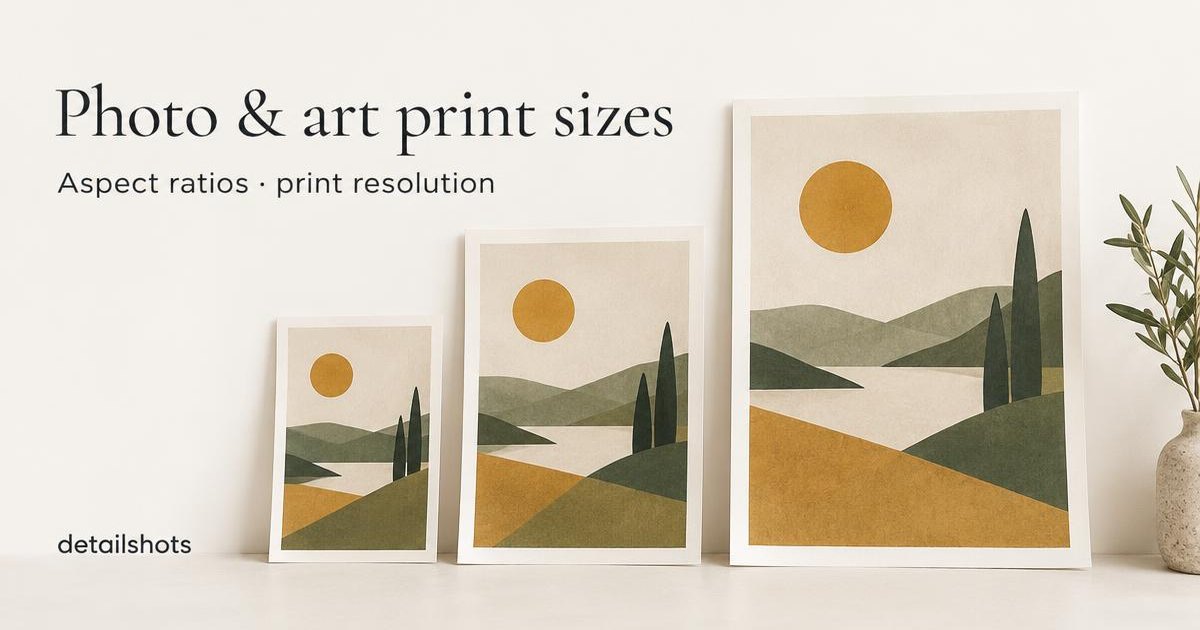
Offer three sizes from one ratio family — for a 4:5 image, 8×10, 16×20 and 24×30 — and show all three on the same wall so buyers see the jump in presence. Most buyers pick the middle option when they can see it at scale.
Questions
What are the standard photo print sizes?
Standard photo print sizes are 4×6, 5×7, 8×10, 11×14, 12×18, 16×20, 20×30 and 24×36 inches. In metric countries the standard sizes are 10×15, 13×18, A4, 30×40, 50×70 cm and the A-series.
How many pixels do I need to print an 8×10?
For a sharp 8×10 at 300 pixels per inch you need 2400×3000 pixels. At 200 ppi, still good at arm's length, 1600×2000 pixels is enough.
How big can I print a phone photo?
A 12-megapixel phone photo is about 4032×3024 pixels: roughly 13×10 in at 300 ppi, or about 20×15 in at 200 ppi. Phones shoot 4:3 by default, so 12×16 in and 18×24 in prints fit without cropping.
Why does my photo get cropped when I print it 8×10?
Most cameras shoot 2:3, but 8×10 is 4:5. Printing a 2:3 photo at 8×10 cuts about an inch off the long side. Print 8×12 instead, or crop deliberately before ordering.
What is the difference between dpi and ppi?
PPI (pixels per inch) describes your digital file; DPI (dots per inch) describes how a printer lays down ink. When a print lab asks for 300 dpi, they mean a file with 300 pixels for every inch of the print.
Show every print size on a real wall.
Free stills with no watermark and no account. Video clips in under a minute.
Keep reading
- Art print mockupFramed art print mockups for print shops and photographers, at real print sizes.
- Poster sizesStandard poster sizes in inches and centimeters, including A-series, with a true-scale wall preview.
- Picture frame sizesStandard picture frame sizes chart with mat openings, in inches and centimeters.
- For photographersOn-wall imagery at real print sizes for photographers selling prints.